William Sheffield
PhD Candidate · Linguistics Department, UT Austin
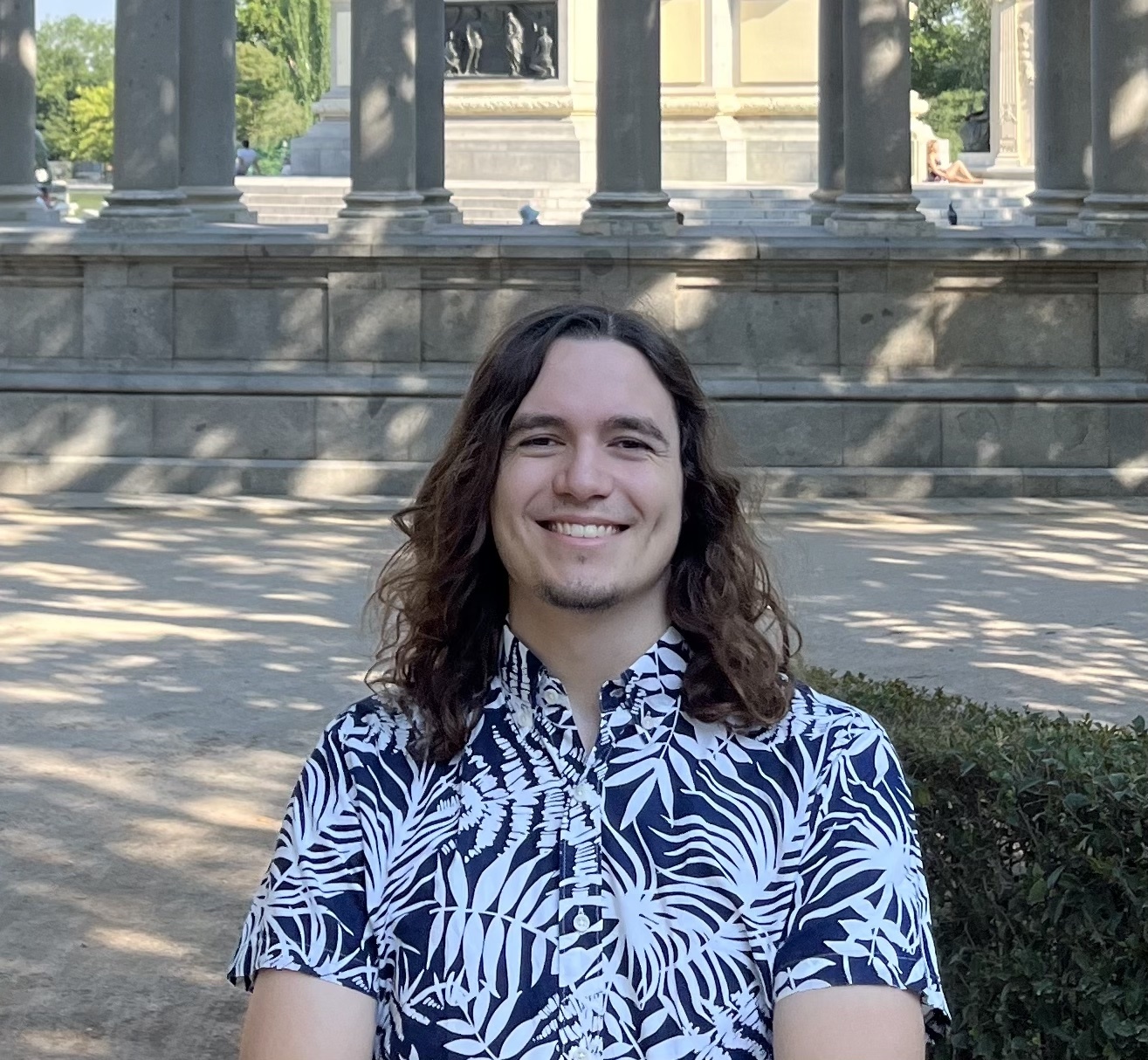
Hello! I'm a PhD candidate in the Linguistics Department at UT Austin, advised by Jessy Li.
I am an AI researcher studying how language models "understand" discourse, or the connection between sentences, by using ideas from formal Linguistics such as Question Under Discussion (QUD), exclusive and discourse particles, and focus.
I am currently on the job market! Please reach out to me at: [last name][first initial][at]utexas[dot]edu
Research
-
2026
Wugnectives: Novel Entity Inferences of Language Models from Discourse Connectives
Proceedings of the 19th Conference of the European Chapter of the Association for Computational Linguistics (Volume 1: Long Papers), 2026
@inproceedings{brubaker-etal-2026-wugnectives, abstract = {The role of world knowledge has been particularly crucial to predict the discourse connective that marks the discourse relation between two arguments, with language models (LMs) being generally successful at this task. We flip this premise in our work, and instead study the inverse problem of understanding whether discourse connectives can inform LMs about the world. To this end, we present Wugnectives, a dataset of 8,880 stimuli that evaluates LMs' inferences about novel entities in contexts where connectives link the entities to particular attributes. On investigating 17 different LMs at various scales, and training regimens, we found that tuning an LM to show reasoning behavior yields noteworthy improvements on most connectives. At the same time, there was a large variation in LMs' overall performance across connective type, with all models systematically struggling on connectives that express a concessive meaning. Our findings pave the way for more nuanced investigations into the functional role of language cues as captured by LMs.We release Wugnectives at https://github.com/kanishkamisra/wugnectives}, isbn = {979-8-89176-380-7}, pages = {6109--6127}, doi = {10.18653/v1/2026.eacl-long.289}, url = {https://aclanthology.org/2026.eacl-long.289/}, publisher = {Association for Computational Linguistics}, address = {Rabat, Morocco}, year = {2026}, month = {March}, booktitle = {Proceedings of the 19th Conference of the European Chapter of the Association for Computational Linguistics (Volume 1: Long Papers)}, editor = {Demberg, Vera and Inui, Kentaro and Marquez, Lluís}, author = {Brubaker, Daniel and Sheffield, William and Li, Junyi Jessy and Misra, Kanishka}, title = {Wugnectives: Novel Entity Inferences of Language Models from Discourse Connectives}, } -
2026
Which course? Discourse! Teaching Discourse and Generation in the Era of LLMs
Proceedings of the Seventh Workshop on Teaching Natural Language Processing (TeachNLP 2026), 2026
@inproceedings{li-etal-2026-course-discourse, abstract = {The field of NLP has undergone vast, continuous transformations over the past few years, sparking debates going beyond discipline boundaries. This begs important questions in education: how do we design courses that bridge sub-disciplines in this shifting landscape? This paper explores this question from the angle of discourse processing, an area with rich linguistic insights and computational models for the intentional, attentional, and coherence structure of language. Discourse is highly relevant for open-ended or long-form text generation, yet this connection is under-explored in existing undergraduate curricula.We present a new course, ``Computational Discourse and Natural Language Generation''. The course is collaboratively designed by a team with complementary expertise and was offered for the first time in Fall 2025 as an upper-level undergraduate course, cross-listed between Linguistics and Computer Science. Our philosophy is to deeply integrate the theoretical and empirical aspects, and create an exploratory mindset inside the classroom and in the assignments. This paper describes the course in detail and concludes with takeaways from an independent survey as well as our vision for future directions.}, isbn = {979-8-89176-375-3}, pages = {45--58}, doi = {10.18653/v1/2026.teachingnlp-1.9}, url = {https://aclanthology.org/2026.teachingnlp-1.9/}, publisher = {Association for Computational Linguistics}, address = {Rabat, Morocco}, year = {2026}, month = {March}, booktitle = {Proceedings of the Seventh Workshop on Teaching Natural Language Processing (TeachNLP 2026)}, editor = {Aßenmacher, Matthias and Biester, Laura and Borg, Claudia and Kovács, György and Mieskes, Margot and Serrano, Sofia}, author = {Li, Junyi Jessy and Liu, Yang Janet and Misra, Kanishka and Pyatkin, Valentina and Sheffield, William}, title = {Which course? Discourse! Teaching Discourse and Generation in the Era of LLMs}, } -
2025
Is It JUST Semantics? A Case Study of Discourse Particle Understanding in LLMs
Findings of the Association for Computational Linguistics: ACL 2025, 2025
@inproceedings{sheffield-etal-2025-just, abstract = {Discourse particles are crucial elements that subtly shape the meaning of text. These words, often polyfunctional, give rise to nuanced and often quite disparate semantic/discourse effects,as exemplified by the diverse uses of the particle *just* (e.g., exclusive, temporal, emphatic). This work investigates the capacity of LLMs to distinguish the fine-grained senses of English *just*, a well-studied example in formal semantics, using data meticulously created and labeled by expert linguists. Our findings reveal that while LLMs exhibit some ability to differentiate between broader categories, they struggle to fully capture more subtle nuances, highlighting a gap in their understanding of discourse particles.}, isbn = {979-8-89176-256-5}, pages = {21704--21715}, doi = {10.18653/v1/2025.findings-acl.1117}, url = {https://aclanthology.org/2025.findings-acl.1117/}, publisher = {Association for Computational Linguistics}, address = {Vienna, Austria}, year = {2025}, month = {July}, booktitle = {Findings of the Association for Computational Linguistics: ACL 2025}, editor = {Che, Wanxiang and Nabende, Joyce and Shutova, Ekaterina and Pilehvar, Mohammad Taher}, author = {Sheffield, William and Misra, Kanishka and Pyatkin, Valentina and Deo, Ashwini and Mahowald, Kyle and Li, Junyi Jessy}, title = {Is It \textit JUST Semantics? A Case Study of Discourse Particle Understanding in LLMs}, } -
2023
Elaborative Simplification as Implicit Questions Under Discussion
Proceedings of the 2023 Conference on Empirical Methods in Natural Language Processing, 2023
@inproceedings{wu-etal-2023-elaborative, pages = {5525--5537}, doi = {10.18653/v1/2023.emnlp-main.336}, url = {https://aclanthology.org/2023.emnlp-main.336/}, publisher = {Association for Computational Linguistics}, address = {Singapore}, year = {2023}, month = {December}, booktitle = {Proceedings of the 2023 Conference on Empirical Methods in Natural Language Processing}, editor = {Bouamor, Houda and Pino, Juan and Bali, Kalika}, author = {Wu, Yating and Sheffield, William and Mahowald, Kyle and Li, Junyi Jessy}, title = {Elaborative Simplification as Implicit Questions Under Discussion}, } -
2022
Evaluating Factuality in Text Simplification
Proceedings of the 60th Annual Meeting of the Association for Computational Linguistics (Volume 1: Long Papers), 2022
@inproceedings{devaraj-etal-2022-evaluating,
  pages        = {7331--7345},
  doi          = {10.18653/v1/2022.acl-long.506},
  url          = {https://aclanthology.org/2022.acl-long.506/},
  publisher    = {Association for Computational Linguistics},
  address      = {Dublin, Ireland},
  year         = {2022},
  month        = {May},
  booktitle    = {Proceedings of the 60th Annual Meeting of the Association for Computational Linguistics (Volume 1: Long Papers)},
  editor       = {Muresan, Smaranda  and
Nakov, Preslav  and
Villavicencio, Aline},
  author       = {Devaraj, Ashwin  and
Sheffield, William  and
Wallace, Byron  and
Li, Junyi Jessy},
  title        = {Evaluating Factuality in Text Simplification},
}
About
I also attended UT Austin for undergrad, where I majored in Mathematics and Linguistics, completed the Elements of Computing certificate, and minored in Russian Language.
When not researching, I attempt to balance my time between too many hobbies, the highlights of which are: hiking, skiing, making origami, cooking, and watching movies.